I wrote this song in 2006. It was the first song that I ever wrote. I wrote it as an acoustic song, this version is same tune/chord structure but more energetic, alternative versus rock ballad. And, how can I know which is better? I can't. I like both versions even though both are very different, even some of the lyrics are different between the versions. This was turning a corner for me. I had written music to lyrics that my brother had written, decades ago, but I had never written my own lyrics and then put them to music. I had done many, many covers in different bands as well, and everything from Black Sabbath to Tom T Hall and everything in between. But I had not found my own voice until I wrote this song...
Verse One: I spend most of my time filling the holes in my head. Sitting in this cell thinking about the life I’ve led. It’s all free food and therapy, but I may as well pay for something I can see… This room has a view but all I really wanna do is talk to you… It’s been so long… How could that be wrong? Everything we had was based on sex money and lies. When you left you took it all… Nothing to keep but alibis…
Hook One: What you took don’t amount to much, but I was never fixed in this world anyway… I was just sitting there waiting on a bus for the next… May as well take my time, I got… Plenty of it… Sometimes it runs late… But I ain’t entertaining offers while I wait.
Verse Two: Listen… I Just want to make this right before I go. Pay my bill or at least knock it down, I don’t know. I wish I could set us free from what we’ve done, but I figured it out, I ain’t the only one… Anyway, I ‘m just learning to walk before I fall again. I’ve been working on change, cleaning up some of this sin, but what’s the good in change… If the world’s still strange. Where’s the sense in being me, if what I was is all you see? Couldn’t stand up kept falling down and that little ball keeps spinning around… All keeps falling apart around me… you say, It will be what it will be…
Hook Two: I could never tell you nothin’ real. It was all about me all of the time. It was easier to hide the way I feel, like you were talking on my dime. I used to believe it was easier to hold it all inside… I never gave you anything… And I know how hard you tried…
Verse Three: Spoken: The snow is falling softly, probably turn to rain later… Sky looks that way… The air has that taste. The wind gusts hard as I step in from the cold… Feels like something familiar, but I haven’t got it placed. I find my way to the small corner table I knew would be there… Cast in shadows, but what are shadows for… And there you are, where you never were, and I find myself wishing I could touch your hand, like I could before… But I know it’s just a dream, I can’t touch you anymore. It’s raining in my mind, I can’t reach you anymore. And if I could I’d write this whole damn thing away… But all I can do is dream… It’s another rainy day…
Verse Four: I spend too much time watching the clock on the wall… You know, sometimes it doesn’t seem to move at all… All keeps stacking up… Cut’s into the emptiness that fills up this cup… And that bus is still running behind and sometimes I get so tired of standing here looking stupid… What the hell was I hoping to find… anyway. Thought about hoping a train… Getting there quicker… But thinking like that only makes me sicker… It’s like my life is stuck in A Minor or something… I don’t know what to do about it, but I know I gotta do something…
Hook Four: But I could never tell you nothin’ real… And I ain’t sayin’ nothin new… It was easier to hide the way I feel… Can you see it the same way too? If we never really had it, what was it you pretended… Was it over long before us or only started once it ended?
Check out this free read of Dreamer’s Worlds and then scroll to the bottom to check out the book links…
ONE
In The Moonlight:
Joe Miller
“Easy… Easy, Boy.” I lowered my hand to the dog’s head and patted affectionately, trying to calm him. He whined low in his throat and looked around at the darkness that closed in on us.
We were in a garage, that much I could tell. Just a nondescript, average run-of-the-mill garage.
The dog lived here. Not the garage specifically. Specifically he lived with, or was owned by, the people that lived on the ground floor of the nearby house. I knew that was true because I lived on the top floor of that same house, even though I had only ever set foot there once or twice, and then only in dreams. I still knew the place. It looked the same. Familiar. The dog, Bear, slept in the garage.
The dog squirmed under my calming hand, whined once again, and then darted out of the garage toward the lower floor of the house. Maybe the first floor. Maybe the basement if he had or could find a way into it. Either way, he was safe now. A kind of exit stage left. Still, I waited a few long minutes to see if he might return, when he didn’t I turned my attention back to the grocery cart I had just pushed for the last few miles to reach the garage.
It wasn’t mine. Well, technically it wasn’t mine, but everything in this world was mine if you came right down to it. I had entered what looked to be an abandoned house and found the cart, already loaded, sitting in an attached garage just off the ground floor apartment. I remember thinking… “So… This is how it begins…
It always begins some way and I suppose that sometimes the ends justify the means, and here was the end… I mean to say that I took the cart, loaded as it was, no more thought involved, pushed it out of the garage at a run and went blindly down the rain-slicked dirt road in front of me.
There was one bad part when I nearly got stuck, but I saw the problem from a long way off, put on a burst of speed and made it through the mud hole and out the other side. It was only a matter of minutes later that I had come in sight of the house and knew what the deal was. I had been contemplating the cart and it’s contents, feeling ears of corn through the side of a large sack, about to check some other stuff, when the dog had appeared.
When the dog came, memories came with him: The house; The people that owned the dog… Returning from work… or? I don’t know. Work or something else. Daily? Was it before things got bad? If so it had to be work: There was nothing else but work before. So work, or something like work… Coming home… The people downstairs… The family upstairs that I knew so intimately, but had never actually seen… Other memories… Leaving to go and get the cart… Knowing it would be there somehow… Getting there… Looping back to here and the present time…
The dog didn’t come back. I stood, the moonlight washing over me: This was critical, all that I had to do was stay there. There meaning upstairs. Stay there. I would be home. I was home. All I had to do was stay. But it never worked out that way. Even as I was thinking about climbing those stairs, checking on the kids, climbing quietly into bed beside my wife, something else was pulling at me, and as I looked around, the big van was parked in the driveway. Almost talking to me. Had it been there a few moments before? A few seconds ago? Surely not. I’d just pushed that cart up that driveway. There had been nothing in it… And that was… Today…? Tonight…? Just a short time ago…? Sure it was.
I let my eyes move around the garage, sweeping over the cart and its load of bundles and packages… Junk too… I hadn’t seen that before… Computer parts? … Maybe… Food and machines. That was ironic. But my mind was not satisfied. The van was there and if the van was there… … I felt in my pockets… … Keys… … And absolutely those keys hadn’t been there a few seconds ago. I could feel their scratchy press against my thigh. Irritating yet comforting… My eyes turned up to the van.
The van was the way out. It could be anyway, if I could simply stay with it… But there was no time to think. Certainly no time to be thinking like that.
More memories came. Memories of always taking the van; always, and… And I couldn’t make the rest of that ghost of a memory come, whatever it was, it was lost to me. … The city… Being lost in the city… Something…. It wouldn’t come, but, well I couldn’t stay here could I?
I glanced towards the house again, expecting the dog to come back… No dog… He had played his part and… And… I looked up at the full, bloated moon. When had I left the garage? I was standing next to the van… Looking in through the drivers window. The keys out of my pocket and into my hand. I could feel their cold, metal weight… Dawn was not far away, if I was going… That was it. The thought just echoed in my head… If I was going I better get going? … If I was going I better get to it? … I better throw away the keys and go in the house? … I better… But I stopped those thoughts. I knew where I better lead to, it lead to, ‘The time is short!’ Once dawn moves in you’ll be stuck! Whatever I had to do in the city with the van had to be done now: Before dawn, or not at all. There was no time to think about it… There never was… I looked down and sucked in a sharp breath.
I let the breath out slowly as my hand fitted the key into the ignition. When had I opened the door? ‘For that matter,’ my mind started, but I shut the door on those thoughts as the van roared to life. I dropped the lever into reverse and for some reason I looked up at the top floor of the house as I did. The lights popped on… A shadow moved behind the curtains of one window… ‘Better go if you’re going,’ my mind whispered. ‘You could stay,’ another voice inside my head countered. ‘Just walk up those stairs…’ the curtain moved in that upstairs window and I quickly turned my eyes aside… I couldn’t see that…. I always turned away: Always…
The van bounced and then lurched out into the street. Gears clashing, transmission whining. The tires chirped as I braked too hard and then slammed the gear shift into drive. The outline of the city glowed in soft yellow light before me. The moonlight bathed the road behind me bright and familiar. After all, how many times had I driven this road? … I sighed, slipped my foot off the brake pedal and let it fall heavily onto the gas. The tires chirped once more as I moved off down the road, snapping the headlights on as an afterthought. Behind me, in the back of the van, the dog whined. I lowered one hand and his head slipped underneath that hand.
“Easy… Easy, Boy,” I said.
In The Moonlight:
Laura Kast
“Easy… Easy, girl, I wont hurt you.” I lowered my hand slowly to let the dog get my scent as I approached the van… Boy, my mind corrected… Boy, Laura…
“Boy,” I said aloud and laughed. But the dog looked like he knew what I had said, cocking his head from one side to the other. His upper lip curled away from his teeth, but he was no longer snarling or growling deep in his chest. “Easy, Boy. Easy, Boy… It’s me, Laura… Easy.” I reached down and he allowed me to rest one hand on his head. I ruffled the thick fur there.
This was new. Did the dog know me? Did I know the dog? I thought about it and realized that at the very least I knew the dog. That didn’t mean the dog knew me. And the dog was definitely not letting anyone near the van. Guarding it. He seemed to consider me on a deeper level, his eyes locked with mine. When had I looked back at him? I couldn’t answer the question. With the dog looking at me like that the question didn’t seen important at all. Wasn’t, important at all, I corrected myself… The dog corrected…?
“You do know me… Don’t you? …Bear?” The dog, who was not a dog, cocked his head to one side and seemed to smile at me. … “Your name is, Bear? … Good, Boy… You’re… Joe’s dog… Bear. Good boy, Bear… Is he here… In the van?” I eased closer as I talked.
Bear watched me, but no longer growled at all. Even the stiff posture he had assumed had changed. His tail dropped and moved slightly. It may have been the beginning of a wag. He whined low in his throat. His eyes reflecting green iridescence in the blue of the moon light. He whined again and then came closer to me, easing his head back under my hand so carefully it seemed as though it had always been there. I rubbed his head once more and then my hand slipped under his jaw, scratching, my head lowered at the same time. Bear whined again and then licked my face.
Laura, you take too many chances, I told myself. Too many. But my hand continued to rub Bear’s head and scratch under his jaw, allowing my racing heart to slow. Catching my breath. Wondering what came next. I was new to this. I had never been this far before. I didn’t know what came next.
“You get in the van,” Joe said from the open window above me.
A small, sharp scream slipped from my throat before I could stop it; sounding like someone was strangling me as I tried to suppress it.
“Jesus… Jesus, Joe… Jesus!”… I managed to get myself back under control after a few seconds. I sucked air back into my lungs. Bear whined and looked up at me. My heart slammed against my rib cage.
“No… Not, Jesus. Thank God it’s not that time,” he said.
I met his eyes, but there was no smile in them. “You scared me,” I said defensively, still breathing hard, chest heaving, heart slamming against my ribs.
“No shit. You think I wasn’t scared too? You’re not supposed to be here … You never have been.” He finished quietly after starting in a loud, strained whisper. His eyes remained on mine. The wind picked up moving the limbs in a huge Elm that stood nearby. Its winter-dead limbs clicking and clacking as they came together. The heavy branches groaning and creaking as the wind momentarily gusted.
The wind continued to build for a few more seconds. Our eyes still locked on one another. Then the wind died down with an audible sigh and I shuddered involuntarily and shifted my eyes away.
“I know… I know,” I started. I moved my eyes back to his, but he just stared at me.
“I do know,” I started again. “I’m not even sure how… How I got here,” I finished quietly.
Bear pushed past me, tail wagging, and jumped up into the van as Joe opened the door.
“That’s how it happens,” he said every bit as quietly as I had started. His eyes that had wandered up to the night darkened sky were back on my own now. Staring at me out of the open door. Bear’s head popped up, looking at me from between the seats.
“Well,” Joe asked?
“What,” I asked? I cocked my head in an unconscious imitation of the way Bear was looking at me.
“Shouldn’t you get in,” he asked? … “Or don’t you want to?”
And that was the question, wasn’t it? Here I was, where I was not supposed to be, where I was not invited to be, where I had never been before and it was time to make the choice.
Bear cocked his head once more as if he were also waiting to hear my answer. The dog that was not a dog at all… a… wolf? Maybe… Maybe more than that too… His green eyes asked the question.
“I get in the Van,” I said quietly.
Joe looked away and then turned quickly back. “Yeah. Yeah. You get in the van and we… We go… It’s nearly dawn… There isn’t much time and we have to get as far as we can before the sun comes up.”
He stretched one hand across the seat, held out to me and I could hear the engine running… When had he started it? … I couldn’t remember. My tongue poked out and licked at my dry lips. Bear seemed to grin. No. Not just a wolf either… One side of his upper lip curled over his teeth.
I found my feet stepping up into the passenger area and I followed…
In The Moonlight:
On The Road With Bear
Joe
I rolled to a stop at the intersection. The city was ahead, the house behind, I had never turned left or right so I had no idea what might be in those directions. Were those two roads, one to the left, one to the right, winding away into the distance, just conceptions? One of those photo realistic things that made you look twice, maybe even more? I looked again.
The roads were night dark, the moon playing hide and seek, gliding in and out of the heavy black clouds. The falling rain distorted both the near road and the distant road. How long had it been raining, I wondered, once the rain finally registered. Big, fat drops formed and rolled off down the slope of the windshield. I reached for the wiper switch but found nothing.
I took my eyes from the windshield and looked, supposing I had put my hand in the wrong place, but I had not. There was simply nothing but a gray, formless mass that slightly resembled the lower half of a dashboard. I blinked and when I opened my eyes once more the wiper switch was there. Exactly where it had not been. Exactly where it should be.
Tired I thought.
Bullshit was my second thought.
I blinked again, but the wiper switch remained. I flicked it on half suspecting that it wouldn’t work. That the wipers, if there were any real wipers, would remain frozen to the glass, refuse to move, but they swept up and pushed the beaded drops of rain from the glass nearly silently. Bear whined and pushed his nose under my hand.
“Alright, Buddy,” I told him. I stroked his head and then looked back out at the road. Left, right, straight, I asked myself.
There was a mystery to the city. Sometimes it went bad for me and sometimes it simply frustrated me.
… Running down the clock… One thing was sure, I had never come back out of the city in the many times that I had driven down into it.
… Left, right, straight, I asked myself again.
I pulled a small wire bound notebook and a pen from my shirt pocket and thumbed it open. Pages and pages of notes on the many times I had gone, but none of them amounted to anything except four entries:
The first entry, page twenty-Six, an address, 52715 Randolph Circle. I had never found Randolph Circle in all of my trips, let alone 52715. I had no memory of ever being there. Of any trip to the city when I may have gone there. I did not remember marking the address into the book. Nothing. A total blank.
The second entry, page twenty-five, read; Be careful of Locust street. Big bold letters. And I remembered being there. I had barely got away with my life.
The third entry, page twenty-seven said; ‘West End Docks.’
I knew that place. I remembered being there, the first time and several other times. But the details weren’t there. I couldn’t see them. Why had I been there? I couldn’t see it. Put my finger on it. There was a long, low building that fronted the docks. A house across the street. An old run down neighborhood. A low, curving concrete wall where I had sat and watched people come and go several times. And more. The feeling that I had been there other times that I could not yet remember. I say yet because I had the feeling that I would remember it. But page twenty-six? Nothing. Nothing at all. Not even a ghost of a memory.
A map would be useful, but there were no maps. It had taken a dozen times or more before I could count on the wire bound note book being in my pocket. Bigger things, like the van, had taken even longer. Before that I had had to walk or steal a car and that was always risky. But there was hope for a map. Someday, just not this day. At least I didn’t think so.
A quick check of the glove box and the engine cover storage area proved that to be true. Nothing useful. And why was it so much useless stuff was there? A spare pen cap… A broken transistor radio, the van had a radio of its own… Sometimes anyway, but there were no stations on the dial, or at least not yet there weren’t. That was another maybe, but it was there, so what good was a broken transistor radio?
Two paperclips. An insurance card, made out to me… For what? A fuzzy life saver, it looked like lime, my least favorite flavor. A flashlight with no batteries, and a dog biscuit. That was new. There had never been a dog biscuit before. Bear whined and gave a little woof in his throat.
I laughed, “It’s yours, Buddy.” He took it gently from my hand. The dry scrape of the Windshield wipers dragged my attention to the windshield. No rain. No rain on the road either. I reached down and flicked off the wipers. At least the switch was still there.
Straight, my mind finally decided. Better the evil that you know. Left and right could wait for another night. I eased off the brake as Bear jumped up onto the passenger seat, rested his paws on the dashboard and watched the countryside pass us by as we made our way into the city.
The fourth entry was on page fifty-eight. A series of numbers. 2757326901. All strung together, followed by a name Laura K. Whole first name, initial only for the last: Like I knew her maybe? I didn’t though. I must have at the time I wrote the number down, but I didn’t now. Who was Laura? Were the numbers a telephone number? Code talk? It bothered me that I had written the entry and yet had no recollection of doing it. Same as Page twenty-six.
I passed the City Limits sign as I wondered. Regular street lights. No traffic. Sometimes there was traffic, sometimes there wasn’t.
The rain began to fall all at once. One second no rain, the next everything was drenched as though it had rained forever: Always; would never stop. I fumbled for the windshield wiper switch once more, but by the time I turned it back on the windshield was clear. No more rain. The road looked as though it had never seen rain, as if it had never been there at all.
I glanced at the speedometer and then lowered my speed. I didn’t need to attract attention. There were cops here and they had no problem putting me in jail. It didn’t seem to matter to them that I was no more real to them than they were to me, off to jail they took me. And before that was all said and done I spent ten days in that jail. Eating Bologna sandwiches, smelling that moldy-pissy jail smell and trying to convince my court appointed lawyer that neither of us were really there. Jail was no good. I had no intention of going back there. I looked once more at the speedometer, backed off a little more, and then passed the sign announcing the city limits.
The city was early morning dead. It wasn’t dawn. If it were I would not have been there, but dawn was close. There was a glow above the city skyline. Faint… Pink… Growing as I sat idling at the intersection waiting for the light to change.
I noticed the rain was falling once more and I had either never turned on the wipers the last time it had rained, or I had turned them off after it had rained. I reached down to flip the switch on and that was when I heard the sound of a heavy engine screaming. Gears clashing. Bear voiced a warning just as my eyes cleared the dashboard and tried to make sense of the scene before them.
There wasn’t much time to absorb it. A garbage truck just feet away from the driver’s door and closing fast. Sirens screaming. Red and blue lights pulsing. Chasing the garbage truck, I wondered? That was nearly the only thought I had time for.
Bear barked again. My eyes focused on the truck only inches away from me, and slowly rose to the driver. A woman… Laura? … Her eyes focused on my own for the split second before the Garbage truck hit the van’s driver door full blast.
Pain exploded inside of me. Faintly, far away, I heard Bear howl in either anger or pain. Then that sound, all sound, was quickly cut off, replaced with a low snapping sound that quickly turned into a heavy crackling sound. The smell of Ozone filled my nose, but something else quickly began to replace that smell. Gasoline. Gasoline and something else… Diesel? And then, with a low wham, the heat came. I struggled to free myself, but it was no use. I had time for one more quick thought … Laura … Laura … Why …? And then the explosion came and the pain flared, then ended almost as fast as it had come and I found myself flying through the blackness of the void… Flying…. Falling… Panic building… Lungs trying to pull a breath… Voice trying to scream… Nothing coming out… Then sight returning in a rush… The street racing up to meet me… The remains of the Van and the Garbage truck burning far below me…. Red and blue lights pulsing… Cars parked aslant in the street where they had skidded to a stop… Cops behind open doors… Crouched to fire… Their guns pointing… Rain falling… The pavement coming closer… So close I could see the individual pebbles of the surface embedded in the asphalt mix…
The impact came with no pain. The remaining air crushed from my lungs… I tried once more to scream, but it was no use… I hit hard, bounced, came down once more and my eyes flew open wide as I impacted the second time…
Gray half-light… The buzzing of the alarm clock… My own sheets tangled around me… Damp with sweat. The red numerals on the clock read 6:47 A.M. I sucked air greedily, like I had never been among the living at all. Never known how to breath. Just returned from the dead. I released my breath in a long, shaky shudder, found myself half sitting up in the bed and fell back to the mattress urging my racing heart to slow… Calming myself… Morning had come.
I reached over, shut off the alarm clock and silence descended on the room. I could hear my heart beating in that silence. Rapidly slamming against the inside of my ribs. Hard. Heavy. Loose and wet. Hear my labored breathing. I lay still for a few minutes watching more color seep into the sky, then got up and made my way to the shower…
Get the books below…
Dreamer’s Worlds: The Dreamer’s Worlds
Laura and Joe are dreamers. When they close their eyes they dream travel through space and time, to other worlds with little more than a thought… #Mythology #Fantasy #Readers #DreamTravel #Kindle
Dreamer’s Worlds: Sparrow Spirit
Book 2 of 2: Dreamer’s Worlds: As Joe and Laura fall deeper into the Dreamer’s Worlds they search to learn more about the legend of Sparrow Spirit… #Mythology #Fantasy #Readers #DreamTravel #Kindle
This book is licensed for your personal enjoyment only. This book may not be re-sold or given away to other people. If you would like to share this book with another person, please purchase an additional copy for each recipient. If you are reading this book and did not purchase it, or it was not purchased for your use only, then please return to your bookseller and purchase your own copy. Thank you for respecting the hard work of this author.
LEGAL
This is a work of fiction. Any names, characters, places or incidents depicted are products of the author’s imagination. Any resemblance to actual living person’s places, situations or events is purely coincidental.
No part of this book may be reproduced by any means, electronic, print, scanner or any other means and, or distributed without the author’s permission. Permission is granted to use short sections of text in reviews or critiques in standard or electronic print.
Dedication
For Joan, my wife, the only dame who ever truly understood the shadows I walked in. This ain’t a love story, not in the conventional sense. There weren’t any moonlit strolls or whispered promises. Hell, most nights, I barely saw you, tucked away in that cramped apartment, the city’s symphony of sirens and shouts a lullaby to our uneasy peace. Our marriage was a deal, a contract hammered out between two bruised souls in a world that chewed up and spat out the soft and sentimental. You knew the game, the rules, the price. You saw the grime under my fingernails, the hollowness behind my eyes, the weight of every case clinging to me like a cheap suit. And still, you stuck around. You knew I wasn’t the knight in shining armor, more like a rusted tin can rattling down a back alley. But you saw something in the wreckage, something worth salvaging, even if it was just the stubborn ember of a flickering heart. This one’s for you, Joan. For the quiet strength you showed, for the unspoken understanding that passed between us in the dead of night, for enduring the man I am, not the man I wish I could be. For enduring the long silences, the averted gazes, the crumpled pay stubs that spoke volumes more than any words could ever say. For holding onto hope when I’d buried mine under layers of cynicism and cheap bourbon. This is a story of shadows, yes, but it’s also a story of the quiet loyalty that can bloom even in the darkest corners. A testament to the enduring power of a bond forged not in romance, but in the shared understanding of a life lived on the edge, where the lines between right and wrong blurred, and the only certainty was the next case, the next drink, the next uncertain dawn. It’s a small offering, this book, a poor substitute for the quiet life you deserved, a life free from the stench of smoke and the stain of violence. But it’s all I have to give, for you, the one woman who ever gave a damn about the crumpled, cynical, hard-boiled egg that is Jack Rourke. This one’s for you. And for the quiet strength you showed, the unspoken understanding, the enduring loyalty, even when there was nothing left to salvage but the embers of a flickering heart.
Chapter 1: The Stakeout Begins
The chipped paint on my beat-up Ford Falcon was flaking like old skin. The smell of stale coffee clung to the interior like a cheap perfume, a constant, bitter reminder of the long hours ahead. Across the street, Paul Fields’ two-story colonial loomed, a picture of suburban perfection, a stark contrast to the cramped discomfort of my temporary office. The relentless hum of traffic on Hemlock Drive was a dull, throbbing ache in my skull, a soundtrack to this tedious ballet of surveillance. My gut churned, not from the coffee, but from the gnawing feeling that I was hemorrhaging money, bleeding my retainer dry on this seemingly pointless stakeout.
Another hour ticked by, the sun inching its way across the sky, dragging the day along like a lead weight. This wasn’t the kind of case that got the adrenaline pumping. No shadowy figures, no whispered secrets in smoky bars, just a comfortable suburban home and a husband who seemed, at least from my vantage point, annoyingly ordinary. Melinda, the wife’s friend who’d hired me, had hinted at something more, something darker lurking beneath the surface of Paul’s apparently mundane life. But so far, all I had to show for five hundred bucks was a sore ass and the lingering taste of cheap coffee.
My gaze drifted to the house. Paul Fields, a man I’d pegged as a mid-level accountant based on the muted grey suit and the slightly receding hairline, was pacing the living room, a nervous energy vibrating off him like a faulty appliance. He kept checking the locks on the doors and windows, a ritualistic act that made my cynicism prickle. It wasn’t paranoia, not exactly; it was more like a compulsive twitch, a nervous habit amplified by whatever was eating at him. Was it guilt? Fear? Or simply the product of a mind overwhelmed by the mundane pressures of suburban existence? My years in this business had taught me that the most ordinary people often held the most extraordinary secrets.
I pulled out my notebook, the cheap paper rustling like dry leaves. I scribbled down a few notes, mostly observations about his movements – the way he nervously adjusted his tie, the slight tremor in his hand as he lit a cigarette, the way he kept glancing at the neighbor’s house as if expecting something, or someone. These weren’t the clues that made headlines, the kind that sold newspapers or landed you on TV. These were the tiny cracks in the façade, the almost imperceptible shifts in behavior that whispered of something amiss. But to the untrained eye, they were just… nothing. In my business, nothing was everything.
My thoughts drifted to Joan, my wife. Marriage, I’d decided long ago, was a complicated equation with too many variables. It was a series of compromises, small betrayals, and occasional moments of fragile intimacy that were often overshadowed by the petty squabbles and simmering resentments. It was a lot like this stakeout, actually: long stretches of tedious waiting, punctuated by brief bursts of activity, and the nagging feeling that it was all ultimately pointless. The money helped, of course. It paid the bills, kept a roof over our heads, even allowed for the occasional bottle of decent scotch. But the money couldn’t buy back the lost time, the quiet evenings that had been sacrificed at the altar of my cynical profession.
The hourly rate gnawed at me. Melinda had paid a hefty retainer upfront, but I was acutely aware of the ticking clock. Every hour spent here was an hour I could have been pursuing a more lucrative case. The guilt was a familiar companion, a shadow that followed me from one job to the next. It was a strange paradox of my profession: the quicker the case, the more guilty I felt, the more I worried about shortchanging my client, and the less I earned. It was a vicious cycle of doubt and self-recrimination, a never-ending loop playing on repeat in the back of my mind.
A memory flickered – Melinda’s face, pale and drawn, her eyes shadowed with worry. She’d met me in the dimly lit back room of a bar downtown, a place that smelled of stale beer and desperation. She’d spoken in hushed tones, her words carefully chosen, veiled in euphemisms. She’d never explicitly accused Paul of infidelity, but the suspicion hung heavy in the air, thick and cloying like the cigarette smoke that drifted around us. She’d spoken of unexplained absences, late nights, and a sudden shift in Paul’s behaviour, an unsettling change in a marriage that had previously been, at least on the surface, stable.
Hours bled into one another, the monotony punctuated only by the occasional car driving past, the rhythmic chirp of crickets from the nearby park, and the rhythmic tapping of my fingers against the steering wheel. Then, a break in the routine. A yellow taxi pulled up to the house next door, a nondescript dwelling with peeling paint and overgrown ivy. A woman emerged, her face obscured by the shadows, but her figure undeniably elegant in a way that contrasted sharply with the slightly shabby surroundings. She walked with purpose, a confident stride that betrayed no hint of hesitation, directly towards Paul Fields’ home.
My gut tightened. This wasn’t in the script. This wasn’t part of the expected narrative. This was a twist, a deviation from the predictable trajectory of a simple infidelity case. The woman disappeared inside Paul’s house, and the image of her silhouette against the lit window pane burned into my retinas. This wasn’t just about a straying husband anymore; this was something else entirely. Something more complicated, more dangerous. The feeling of dread wasn’t the familiar pang of anxiety associated with a looming deadline, but the sharper, colder fear of venturing into unknown territory. This stakeout, it seemed, was about to get a lot more interesting. And a lot more expensive for Melinda. And potentially, for me. The night was young, and the city held its breath.
The afternoon sun beat down on the Falcon’s dashboard, turning the interior into a small, sweltering oven. The smell of stale coffee had been joined by a new, unwelcome aroma: the faint, metallic tang of sweat. My shirt clung to my back, damp and uncomfortable. Paul Fields remained inside, his movements a blur behind the drawn curtains, but the overall impression was one of restless energy, a caged animal pacing its confines. He’d gone through the lock-checking ritual at least five times in the last hour, each repetition more frantic than the last. It wasn’t a subtle thing, this anxiety; it was practically radiating from the house, a palpable energy that even I, hardened veteran of countless stakeouts, couldn’t ignore.
I reached for my thermos, the lukewarm coffee a bitter disappointment. It did little to soothe the growing unease that was beginning to coil in my stomach, a knot of apprehension tightening with every passing minute. This wasn’t just a case of a possibly cheating husband; it had taken on a darker, more sinister edge. The obsessive checking of locks and windows wasn’t the behavior of a man hiding an affair; it was the behavior of a man hiding something far more significant. Something he was desperately, almost desperately afraid of losing.
My notebook lay open on my lap, filled with meticulous observations: the brand of cigarettes he smoked (Chesterfield, king size), the precise time he lit each one, the way he ground the butt into the ashtray with an almost aggressive force. These weren’t the glamorous details that made for a sensational story; they were the mundane breadcrumbs, the almost imperceptible clues that only someone with my experience could decipher, could weave into a narrative that held any real significance. But for now, they remained just that: breadcrumbs.
The hours stretched, each one a slow, agonizing crawl. The cityscape around me began to blur, the incessant drone of traffic merging into a single, hypnotic hum. My attention wavered, drifting from the house to my own life, the internal dialogue a familiar companion. Joan would be at home now, probably working on her latest watercolor painting, the gentle strokes of her brush a stark contrast to the harsh reality of my existence. I often wondered if she felt the same sense of unease, that same gnawing feeling of something being wrong, even when things seemed perfectly normal on the surface. Maybe she did; maybe that’s what kept us together, that shared unease, that unspoken awareness that beneath the surface of our seemingly stable marriage lay a chasm of unspoken words and quiet resentments.
I caught myself staring at the neighbor’s house again – the one the woman had emerged from. It was unremarkable, a typical suburban dwelling, slightly run-down and unkempt. Yet, it held a certain morbid fascination. It felt…significant. Like a piece of a puzzle I hadn’t yet found, a missing fragment in a picture I was slowly, painfully putting together. The woman had been striking, elegant in her simplicity, with a certain air of determination about her. She had entered Paul’s house without a second glance, her movements purposeful, even resolute. There was an understanding between them, a silent agreement that I couldn’t quite grasp. What was the nature of this interaction? Was she an accomplice, a confidante, or something more sinister?
The sun began its slow descent, casting long shadows across the street. The air cooled, the oppressive heat of the afternoon giving way to a cooler, more ominous evening chill. Paul Fields was less agitated now, but a subtle tension remained, a nervous stillness that was almost more unsettling than his earlier frenetic energy. He sat by the window, a drink in his hand, staring out into the gathering dusk. What was he looking for? Who was he expecting?
I checked my watch. The retainer was almost exhausted. Melinda’s initial payment, generous as it was, was quickly dwindling. The guilt gnawed at me again, the familiar pang of professional anxiety. I was spending more time on this case than I’d initially anticipated, and the hourly rate was a constant reminder of the dwindling financial returns. Was I overstepping my professional boundaries, letting my curiosity, my personal fascination with the case, cloud my judgment? I’d always prided myself on my objectivity, my detachment; but this case…this case was different.
A sudden noise broke through my thoughts – a low, rhythmic tapping against the glass of the window. I jerked my head up, my heart hammering against my ribs. It was coming from Paul Fields’ house, a slow, deliberate tapping, repetitive and insistent. My hand instinctively went to my pistol, a familiar weight offering a semblance of comfort, a grim reassurance in the growing darkness.
The tapping ceased. Paul Fields had disappeared from the window. Silence descended, heavy and oppressive, thick with an unspoken tension. The only sound was the distant hum of city traffic, and the faint, incessant chirping of crickets. The seemingly insignificant details I’d meticulously recorded in my notebook – the nervous tie adjustment, the tremor in his hand, the aggressive way he extinguished his cigarettes – these seemingly inconsequential observations took on a new, more profound significance. They were no longer just details; they were pieces of a puzzle, fragments of a story slowly, painfully unfolding before me, a story that promised to be far more complex, far more dangerous, than I’d initially imagined.
The night was settling in, and with it, a sense of foreboding that ran deeper than any simple case of infidelity. This was about secrets, lies, and a fear so profound it permeated every corner of Paul Fields’ carefully constructed suburban existence. The stakeout was far from over. In fact, I had a feeling it was just beginning. The truth, I suspected, lay buried deep, waiting to be unearthed, and my gut told me the cost of discovering it would be far greater than I’d ever anticipated. The woman’s visit had shifted everything, changing the stakes of the game. My job had moved beyond the simple pursuit of a cheating spouse; it had transformed into something far more complex, something that touched on the very fabric of human deception and its potentially lethal consequences.
The rhythmic tick-tock of the Falcon’s clock mocked the stillness of the evening. Each second felt stretched, an eternity of waiting. My mind, however, was far from the stakeout, adrift in the turbulent waters of my own marriage. Joan. The name itself felt like a worn coin, smooth from years of handling, its initial shine dulled by the relentless friction of daily life. We’d been together for fifteen years, a lifetime in some ways, a blink in others. The honeymoon phase had long since faded, replaced by a comfortable, if somewhat predictable, routine. We shared a life, a house, a bank account, but did we really share a soul? Was there still a spark, or was the flame reduced to a flickering ember, barely clinging to life?
The question gnawed at me, a persistent ache mirroring the dull throbbing in my temples. Marriage, I’d come to realize, was a constant negotiation, a delicate balancing act between individual desires and shared responsibilities. It was a dance of compromises, of unspoken expectations and carefully constructed compromises. Sometimes it felt more like a business deal than a partnership forged in love and passion. The paperwork – the joint accounts, the insurance policies, the mortgage payments – felt strangely analogous to the meticulous notes I kept on Paul Fields, each entry a careful accounting of actions, reactions, a meticulous record of a decaying trust.
Melinda, Paul’s wife’s friend, had paid handsomely upfront; a generous retainer, enough to keep me comfortably occupied for a week, even two. But the thought of the hourly rate – that constant, nagging reminder of the money I was burning – prickled my conscience. There was an insidious guilt that always followed a swiftly resolved case; a feeling of having cheated the system, of not earning my keep. This wasn’t a lavish life, detective work. It was more about steady income, keeping the wolves from the door, enough to keep Joan and I afloat. Yet, that constant pressure to justify my expenditure, to always be productive, mirrored the pressure in my marriage, where every moment seemed judged and accounted for.
Were we, Joan and I, simply two people going through the motions, enacting the rituals of marriage without the substance of genuine connection? Did the quiet silences between us represent a void, or simply the comfortable silence of two people who’d learned to live in harmony, even without passion? It was a question I’d avoided for too long, burying it beneath the layers of routine and responsibility. The work had become a convenient distraction, a shield against the introspective exploration of my own life.
The thought of Paul Fields’ situation – a man seemingly trapped in a web of his own making – stirred a painful resonance. Was his desperate need to secure his house an external manifestation of the same anxieties that gnawed at me? A fear of losing something precious, something irreplaceable? Or was it something darker? Something far more sinister than a simple midlife crisis or a clandestine affair? The more I observed him, the less certain I became of the original briefing. Infidelity seemed almost too simplistic, an inadequate explanation for the level of paranoia and anxiety I had witnessed.
The darkness deepened, swallowing the last vestiges of the day. The city lights twinkled, a distant, cold constellation in the vast expanse of night. My eyes remained fixed on Paul Fields’ house. The silence was broken only by the occasional rustle of leaves and the distant murmur of traffic. Yet, the stillness was deceptive. Beneath the surface, a current of tension flowed, a palpable sense of unease that tightened its grip with every passing moment.
I considered Joan again. Her world was a study in contrasts to mine. The vibrant colors of her paintings, the meticulous detail of her brushstrokes, the quiet satisfaction she derived from creating something beautiful; these represented a life that was completely separate from my gritty world of shadows and suspicion. We were two ships passing in the night, each sailing on a different sea. And yet, somehow, inexplicably, we’d found ourselves docked together, sharing a harbor, a home. But was it enough? Was this fleeting contentment what our lives were to become, or did a future of potential storms still await us?
My thoughts returned to Melinda’s initial payment, the generous upfront sum. It was enough to sustain us for several weeks, but the nagging feeling of not truly
earning it persisted. The hourly rate, a constant, insidious reminder of my own professional limitations. The case, initially expected to be straightforward, had become something else entirely, something that stretched the boundaries of my professional competence. The initial impression of a typical marital discord had morphed into something far more complex and unsettling, a mystery that wrapped around me, pulling me in like a relentless tide.
Was this my problem, the one I felt increasingly drawn to resolve? I often felt more satisfaction in the conclusion of a case, and not necessarily its financial rewards. The financial rewards were only relevant to the continuation of this lifestyle I was beginning to question. I knew, deep down, that there was something more to this than the potential for monetary gain. The thrill of the chase, the satisfaction of unraveling the complexities of human behavior, the dangerous dance between truth and deception; these were the aspects that truly captivated me. They were the reasons why I chose this path, why I continued to walk this lonely road, amidst the darkness and the shadows.
But the darkness was getting to me. It was creeping in, threatening to engulf me entirely, to swallow me whole. The night pressed down, heavy and suffocating. My initial feelings of guilt over a quickly resolved case had given way to a different kind of guilt, the gnawing sense of responsibility that came from recognizing the gravity of the situation. This wasn’t just about infidelity; this was about something far more profound, something that touched upon the very essence of human nature, the secrets we keep, the lies we tell, and the terrifying consequences of our actions.
The tension remained palpable, hanging heavy in the air like a shroud. The silence stretched, agonizing, unbroken. I watched, waiting, for the next clue, the next piece of the puzzle. The cost of the stakeout was going up exponentially, not just financially, but emotionally. What started as a simple, even mundane, job had evolved into something far more complex, a mystery that promised to be both exhilarating and potentially dangerous, a game with high stakes. And the game, it seemed, was just beginning. The shadows deepened, and with them, the unsettling feeling that I was venturing into territory that was far beyond my initial expectations. The line between professional curiosity and personal obsession was becoming increasingly blurred, and I had no idea where that would ultimately lead.
The memory flickered, a hazy snapshot in the stark contrast between the sterile brightness of my office and the shadowy suburban street where I now sat. Melinda. Her face, etched with a mixture of apprehension and determination, swam back to me. She’d arrived late that afternoon, a figure shrouded in a heavy winter coat, her breath misting in the cold air of my waiting room. The dim lighting of my office seemed to amplify her nervousness, highlighting the tremor in her hands as she clutched a worn leather purse. She’d been introduced through a mutual acquaintance, a lawyer I’d worked with on a few prior cases. Her initial reluctance to divulge details, the carefully chosen words, the veiled allusions – they’d hinted at something far more complicated than a simple case of marital infidelity.
“It’s… it’s about Paul,” she’d begun, her voice barely a whisper, as if afraid the very air might carry her secret. “My best friend’s husband. Sarah… she suspects something. Something’s not right. She’s too afraid to… to confront him herself.”
There was a hesitant pause, a brief silence broken only by the rhythmic tick of the clock on my desk. It was a sound oddly familiar to the one I was now listening to, the rhythmic ticking that filled the night here on my stakeout. The similarities between the two settings were unsettling, the echoes of that initial consultation creating a weird sense of déja vu.
“It’s not just… you know… another affair,” she continued, her voice gaining a slight measure of resolve. “It’s… different. More… dangerous.”
The word “dangerous” hung in the air, heavy with unspoken implications. She refused to elaborate further, merely offering a series of vague pronouncements; unusual late-night meetings, strange phone calls, and a pervasive sense of unease that permeated their otherwise seemingly stable life. She hadn’t spoken of specifics, only impressions, vague feelings, hinting at a darkness that lay just beneath the surface of their comfortable suburban existence. The fear in her eyes, however, had been palpable. It was a fear that transcended mere infidelity, a fear that spoke of something far more sinister, something that went beyond the usual marital squabbles and clandestine encounters.
She’d paid handsomely, a significant advance that far exceeded the typical retainer for a simple infidelity investigation. The money had felt… heavy, as if burdened with the weight of her anxieties, her unspoken fears. The generous payment had raised my suspicions, fueling my intuition that this was no ordinary case. It suggested there was more at stake than just catching Paul with another woman, that the truth was buried far deeper, far more elusive than a quick snapshot of infidelity.
I’d tried to draw her out, to coax more information from her, but she’d remained tightly wound, her lips sealed as if bound by an invisible oath. She spoke in coded messages, her words carefully chosen to conceal more than they revealed, her eyes constantly darting around the room as if expecting to be overheard. The overall impression was one of extreme urgency, a sense of impending doom that she couldn’t quite articulate, but that resonated powerfully with me.
The contrast between that dimly lit office, heavy with unspoken anxieties and the hushed quiet of the night outside Paul Fields’ house was stark, yet somehow fitting. Here, in the darkness, surrounded by the slumbering suburbia, I felt a similar weight of anticipation. The silence, which I’d initially found tedious, now held a different, more compelling meaning. It was a silence pregnant with secrets, a silence that vibrated with the unspoken tensions of the lives I was observing.
My eyes remained fixed on Paul’s house. The rhythmic ticking of my watch—a different watch, but the rhythm was the same, a constant companion—accompanied the sound of the crickets chirping in the nearby woods. Paul remained inside, a shadowy figure hidden behind the drawn curtains. His movements, even those few I could see, were restless, anxious. He kept pacing, checking the locks on the doors, peering out the windows as if expecting an intruder. It all fit with Melinda’s description, a feeling of being watched, of being under siege, not necessarily by a person, but by an unseen force. An unseen force that, in my growing suspicion, might be far more powerful and dangerous than just the threat of a love affair gone wrong. Perhaps Melinda herself was in danger. Perhaps Paul was, too. The initial case—infidelity—was losing its significance, becoming secondary to something else entirely. Something more complex, and infinitely more disturbing…
Check out the series below:
Private Investigations: The John Rourke Private Detective series
John Rourke is a private detective with contacts and a license to practice from New York to Arizona. He has the resources he needs across the country to find the information he needs to crack the toughest cases. Ex-cops, ex-Cons, snitches, stoolies, drug addicts, criminals, drug dealers and any kind of scum of the earth you can imagine or care to name. He knows the seedy side of life and to some people that makes him indispensable…
Book one:
The chipped paint on my beat-up Ford Falcon was flaking like old skin. The smell of stale coffee clung to the interior like a cheap perfume, a constant, bitter reminder of the long hours ahead. Across the street, Paul Fields’ two-story colonial loomed, a picture of suburban perfection, a stark contrast to the cramped discomfort of my temporary office. The relentless hum of traffic on Hemlock Drive was a dull, throbbing ache in my skull, a soundtrack to this tedious ballet of surveillance. My gut churned, not from the coffee, but from the gnawing feeling that I was hemorrhaging money, bleeding my retainer dry on this seemingly pointless stakeout…
Private Investigations 2: A John Rourke detective Story (Private Investigations: John Rourke Private Detective Stories) Kindle Edition Book 2 of 3: Private Investigations: John Rourke Private Detective Storiesby W. W. Watson(Author)Format: Kindle Edition J Book 2 of 3: Private Investigations: John Rourke Private Detective Stories John Rourke is a private detective with contacts and a license to practice from New York to Arizona. He has the resources he needs across the country to find the information he needs to crack the toughest cases. Ex-cops, ex-Cons, snitches, stoolies, drug addicts, criminals, drug dealers and any kind of scum of the earth you can imagine or care to name. He knows the seedy side of life and to some people that makes him indispensable…
Book two:
My apartment, usually a sanctuary of quiet solitude, became a temporary forensic lab. The dining table transformed into a command center, littered with maps, photographs, financial records, and transcripts of intercepted phone calls. The air hung heavy with the scent of stale coffee and the lingering aroma of cheap takeout containers. Days bled into nights as I painstakingly organized the evidence, meticulously documenting every detail, creating a comprehensive narrative that would stand up to the scrutiny of the legal system… #BookWorm #Readers #KindleUnlimited #WWWatson #Crime #Noir #Mystery #PrivateEye
John Rourke is a private detective with contacts and a license to practice from New York to Arizona. He has the resources he needs across the country to find the information he needs to crack the toughest cases. Ex-cops, ex-Cons, snitches, stoolies, drug addicts, criminals, drug dealers and any kind of scum of the earth you can imagine or care to name. He knows the seedy side of life and to some people that makes him indispensable…
Book three:
The silence was broken by the distant screech of a hawk, its cry sharp and piercing against the vast silence of the desert. It was a lonely sound, a perfect metaphor for the state of my own soul. I was tired, bone-deep tired. Sleep was a luxury I couldn’t afford, nightmares a constant companion. The faces of the victims, the ones I’d found along Rieser’s trail, haunted my dreams. Each one a testament to the brutal efficiency of a man who knew how to erase his tracks… #BookWorm #Readers #KindleUnlimited #WWWatson #Crime #Noir #Mystery #PrivateEye
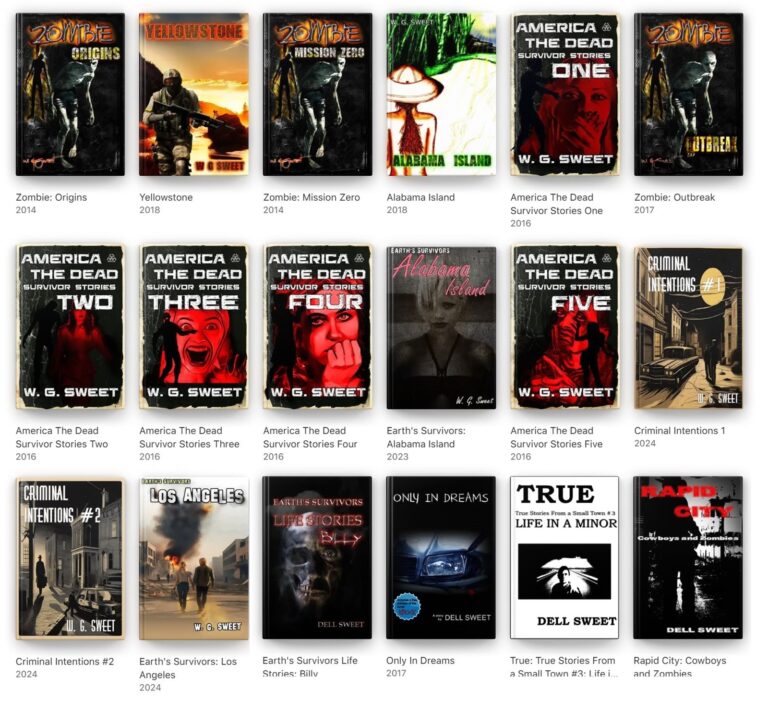
by Dell Sweet (Author) , W. G. Sweet (Author) , George Dell (Author) and 2 more
Kindle, Audible Logo Audiobook, Hardcover, Paperback, By Dell Sweet
In the small city of Glennville people tend to stay to themselves. Neighbors matter. The streets, even in the poorest of neighborhoods are safe for children to travel on their own. But the city has its secrets, and those secrets have their dangers. Under the city, a series of caves cut from the limestone by the Black River attract visitors, children, some have entered and never come out; maybe lost, maybe part of Glennville’s secrets. Something else lives in the cold, dark caves. Something some have suspected but refused to believe. After all, things in Glennville are rational, safe…
Glennville is a series of books that play out in the City of Glennville or that are somehow connected to the city of Glennville, Dell Sweet
The city breathed with a rhythm all its own, a symphony of sounds and smells that were as much a part of Vinnie LaRosa as his own heartbeat. Little Italy, mid-20th century, was a vibrant, chaotic organism, its narrow streets a pulsing artery crammed with life. From the cramped tenements that clawed at the sky, their fire escapes a tangled lace against the brick, to the bustling trattorias that spilled the rich, intoxicating aroma of simmering tomato sauces and roasted garlic onto the cobblestones, the neighborhood was a constant, humming presence. Laundry flapped like colorful prayer flags from windows, a cacophony of Italian dialects spilled from doorways, and the ever-present rumble of streetcars added a bass note to the urban opera. #Crime #Fiction #Amazon #KU #Kindle #WGSweet #Mafia #Organizedcrime
The city sprawled beneath him, a glittering tapestry woven with threads of ambition and illuminated by a million indifferent stars. From the aerie of his penthouse, high above the cacophony of the streets, Vinny LaRosa surveyed his kingdom. It wasn’t a kingdom of stone and mortar, but of shadow and influence, a sprawling, illicit empire that pulsed with a life of its own. The lights weren’t just streetlamps and neon signs; they were signals, markers of territories controlled, deals brokered, and lives manipulated. Each flicker was a testament to his reach, a silent acknowledgment of the power he wielded. This was the zenith, the apex of his ascent, a plateau of opulence built on a foundation of calculated ruthlessness and an almost supernatural understanding of the human appetite for both order and chaos. #Crime #Fiction #Amazon #KU #Kindle #WGSweet #Mafia #Organizedcrime
The Small town of Glennville New York is a nice quiet place to settle down and raise your family. At least that is What Sheriff Kyle Stevens thought when he retired after being a detective in New York City for twenty years. And Glennville, for the most part was quiet. Respectfull. Safe. Until the day Kyle’s deputy for the body of a young girl out by the old abandoned school building…
“We need to get out of sight,” Candace said, her voice low and urgent. “Now.” They ducked behind a row of overturned buses, the metal cool against their skin. Candace peered through a shattered window, her heart thudding against her ribs. The group consisted of about six individuals, all clad in dark, functional clothing, their faces obscured by masks and goggles. They moved with a predatory grace, their weapons held at the ready. They weren’t simply passing through; they were patrolling, searching. “They’re looking for something,” Candace observed, her mind racing. “Or someone.” The encounter in the alleyway had clearly been no isolated incident. The symbols on the buses, the presence of this armed patrol – it all pointed to a more organized, more deliberate presence in this area. This wasn’t just a random patch of ruined city; it was territory that was being actively claimed and defended. As the patrol drew closer, Candace noticed something peculiar about their gear. While functional, it also bore subtle markings, similar in design to the symbols on the buses, but rendered in a metallic thread that seemed to catch the scant light. It suggested a degree of uniformity, of affiliation, that was unsettling…
Chronicles from the Wastelands 02 Before Candace could speculate, a low, guttural growl echoed from the far end of the depot, followed by the distinct sound of heavy boots crunching on gravel. It was a sound of human origin, but there was an aggression to it, a territoriality that sent a prickle of alarm through Candace. “Someone else,” Elara whispered, her hand tightening on her pipe. Candace nodded, her gaze fixed on the source of the sound. “And they don’t sound friendly.” She could see them now – a group of figures emerging from the gloom, their silhouettes indistinct against the muted light. They were armed, their weapons glinting dully. Their movements were coordinated, purposeful, suggesting a trained unit rather than a disorganized band of scavengers. #Dystopian #Apocalyptic #Epic #Survival #Amazon #Kindle #KU #Horror https://www.amazon.com/gp/product/B0G8T68GQFhttps://youtu.be/eWor0A3iAY8
Chronicles from the Wastelands 01 The collapse had been a swift, brutal amputation. The surge, a cataclysmic event that had not only silenced our digital world but had also plunged vast swathes of the planet into darkness and disarray. The immediate aftermath had been a blur of panic, of desperate attempts to comprehend the incomprehensible. The abstract threats of cyber warfare or economic collapse had been replaced by the terrifyingly concrete realities of starvation, disease, and the primal struggle for survival. In the early days, the focus had been singular: survive. Find food, find water, find shelter. My technical skills, so vital in the old world, were largely useless. I learned to scavenge, to ration, to move with a stealth born of necessity. I learned the silence of the wilderness, the language of rustling leaves and snapping twigs. But survival, I was discovering, was not an end in itself. It was a means to an end, a precarious foundation upon which something more must be built. It was a recognition that to truly survive, I needed to do more than just exist; I needed to be. #Dystopian #Apocalyptic #Epic #Survival #Amazon #Kindle #KU #Horror https://www.amazon.com/dp/B0G8VDRW4Chttps://youtu.be/xEO0R-NsW9Q
This is a work of fiction. Any names, characters, places or incidents depicted are products of the author’s imagination. Any resemblance to actual living person’s places, situations or events is purely coincidental.
No part of this book may be reproduced by any means, electronic, print, scanner or any other means and or distributed without the author’s permission.
Permission is granted to use short sections of text in reviews or critiques in standard or electronic print.
Chapter 1: The Burning House
The acrid smell of burnt wood and something else, something sickeningly sweet and acrid, hung heavy in the air. Sheriff Kyle Stevens squinted against the still-flickering flames, the orange glow painting grotesque shadows on the ravaged remains of Turk Hayley’s house. It was a mess, a chaotic jumble of twisted metal, shattered glass, and charred timbers. The fire had been fierce, consuming everything in its path with brutal efficiency. He’d received the call just after midnight – a raging inferno engulfing a house on the outskirts of Glennville. Now, standing amidst the ashes, the early morning chill did little to counter the gnawing unease that settled deep in his gut.
A fireman, his face smudged with soot, approached Stevens, his voice strained above the crackling embers. “Found a body, Sheriff. Near the back.”
Stevens followed him, his boots crunching on broken glass and pulverized brick. The closer he got, the stronger the sickly sweet smell became – a metallic tang that clung to the back of his throat. They reached a relatively clear patch where a body lay partially obscured by a fallen beam. The remains were badly burned, but even in the dim light, Stevens could tell the victim was a man. The fireman carefully moved the beam, revealing a twisted, charred limb. The sight, brutal and stark, sent a jolt of adrenaline through Stevens. This wasn’t just another house fire.
As the paramedics began their grim work, Stevens surveyed the scene. The fire had started in the back of the house, near the kitchen, the fireman had reported. The pattern of the burn suggested a rapid spread, consistent with accelerant. But the layout of the house suggested a different story. The wind, a fierce gust from the south, should have pushed the fire towards the front, not contained it to the rear. It was a small detail, perhaps insignificant, but it planted a seed of doubt in Stevens’ already troubled mind. Something wasn’t right. The air itself felt heavy, charged with unspoken truths and unanswered questions.
The fire marshal arrived shortly after, a harried man named Miller, his eyes bloodshot from lack of sleep. He surveyed the damage with a professional eye, his clipboard a shield against the chaos. After a cursory examination, Miller muttered something about accidental causes, possibly a faulty electrical wire. It was the expected conclusion; a tragic accident, another scar on the otherwise quiet town of Glennville. But Stevens remained unconvinced. The way the fire had spread, the unusual intensity, the lingering smell – these things whispered of a different narrative, a darker tale woven from malice and deception.
The discovery of the body complicated things considerably. Miller, pragmatic and weary, barely registered the finding as anything unusual. “Another casualty of the fire, I suppose,” he’d murmured, his gaze already shifting to his report. But for Stevens, the presence of the body shifted the entire investigation from a simple fire incident to a potential homicide. A nagging suspicion, cold and hard, formed in his gut: this wasn’t an accident.
The body was eventually identified as Arthur Abernathy, a reclusive neighbor who lived a stone’s throw from the Hayleys. A recluse, yes, but a harmless one, according to what little Stevens had managed to gather from the few people who’d ever interacted with him. Abernathy, a frail, elderly man who kept to himself and his small garden, had seemingly become an unintended victim in the inferno. But Stevens couldn’t shake off the feeling that Abernathy’s death wasn’t a random consequence of the fire. The placement of the body, partially shielded yet undeniably exposed, seemed… deliberate. The early stages of the investigation already seemed to be building a case against the randomness of events.
Meanwhile, May Hayley, Turk’s wife, arrived at the scene, a small, fragile woman clad in a flimsy nightgown and bathrobe. Her face was streaked with soot and tears, but a flicker of something else, something that resembled relief rather than grief, momentarily crossed her features. It was a fleeting expression, quickly masked by the performance of overwhelming sorrow. Stevens made a mental note of it. The display of grief didn’t quite ring true. There was a coldness in her eyes, a distance that hinted at a deeper, more complex story beneath the surface. He watched her as the paramedics worked, a silent observer picking up on the nuances of her grief, or lack thereof.
The initial interviews with the neighbors were equally unsettling. They spoke of the Hayleys in hushed tones, their words laced with a mixture of fear and resentment. Turk Hayley, they said, was a volatile man, prone to fits of rage. He was a man known for his loud arguments and unpredictable behavior, a fact confirmed by the numerous reports filed against him for minor infractions over the years. The accounts confirmed a volatile relationship between Turk and May, punctuated by explosive arguments and threats. Christine, their daughter, was rarely mentioned, only ever referenced in passing, described as “troubled” or “rebellious.” The neighbors seemed reluctant to divulge much, their fear palpable in their hushed whispers and darting glances…
Check out the book…
Small Town Murder: A Kyle Stevens Murder Mystery (Glennville Book 12) Kindle Edition
Small town murder
The Small town of Glennville New York is a nice quiet place to settle down and raise your family. At least that is What Sheriff Kyle Stevens thought when he retired after being a detective in New York City for twenty years. And Glennville, for the most part was quiet. Respectfull. Safe. Until the day Kyle’s deputy for the body of a young girl out by the old abandoned school building…